THE AI BOOM IS CREATING A NEW SUPPLY-CHAIN BOTTLENECK
Everyone is watching GPUs.
Far fewer people are watching the components behind them.
Yet memory, advanced PCBs, substrates, laminates, and manufacturing capacity may become the real factors that determine which AI programs scale and which ones stall. As AI infrastructure expands at an unprecedented pace, demand is shifting deeper into the electronics supply chain, creating pressure on qualified manufacturing capacity long before a completed server reaches the data center.
The next AI bottleneck may not be the processor itself. It may be everything required to support it.
01: MEMORY HAS MOVED FROM COMPONENT TO STRATEGIC ASSET
AI workloads are changing the economics of memory. Training and inference require enormous bandwidth and increasingly large memory footprints. Manufacturers are therefore directing capacity toward HBM, server-class DDR5 and high-capacity storage products while conventional consumer demand competes for a smaller share of incremental supply.
“System performance is now driven by memory bandwidth and memory capacity, more than ever before.”
Sumit Sadana, Executive Vice President & Chief Business Officer, Micron Technology, COMPUTEX 2026
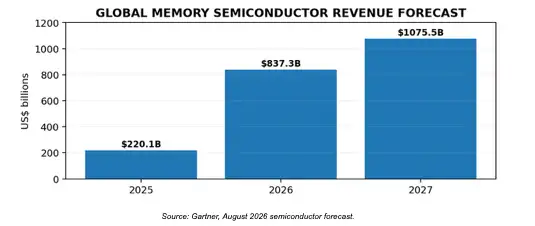
Gartner’s August 2026 forecast puts the scale of the shift into perspective: global memory semiconductor revenue is forecast at $220.1 billion in 2025, $837.3 billion in 2026 and $1.0755 trillion in 2027. Gartner also expects supply-demand conditions to remain tight as AI infrastructure continues to consume memory.
02: THE ALLOCATION PROBLEM IS REAL
The clearest signal is not simply price. It is allocation. When the highest value applications receive priority, manufacturers can sell a large portion of output before it reaches the open market. That changes procurement from a spot-buying exercise into a capacity-planning exercise.
SK hynix described the current HBM market with a striking detail from COMPUTEX 2026: NVIDIA CEO Jensen Huang wrote “Please Make More” on an HBM4E wafer. The phrase became an unusually direct illustration of how tight the AI-memory relationship has become.
“Please Make More”
Jensen Huang’s handwritten message on an SK hynix HBM4E wafer, as reported by SK hynix
The squeeze is not confined to HBM. Gartner expects DRAM prices to rise sharply in 2026, while server demand remains prioritized. Reuters has also reported that Chinese AI-chip companies raised accelerator prices as the global HBM shortage intensified.
03: PCBS ARE BECOMING PART OF THE AI BOTTLENECK
The PCB is often treated as a commodity line item. At the high end of AI infrastructure, that assumption breaks down. AI servers need large-format, high-layer-count boards, tighter impedance control, low-loss materials, and increasingly complex power-delivery structures.
The Printed Circuit Engineering Association reports strong demand for AI-server PCBs above 40 layers and ultra-low-loss characteristics, pushing the global copper-clad laminate market from about $16 billion in 2025 toward $21.5 billion in 2026.
The supply pressure also reaches upstream materials. Copper foil, glass fabric, resin systems and specialty laminates become capacity constraints when every new generation of server hardware consumes more board area, more layers and more demanding signal-integrity specifications.
04: THIS IS A STRUCTURAL SHIFT, NOT JUST A SHORTAGE
Reuters reported that PCB prices rose as much as 40% in April 2026 amid shortages of copper foil, epoxy resin and glass fiber, while manufacturers faced longer lead times. That disruption matters because a PCB shortage can stop a complete system even when the headline processor is available.
Supply-chain intelligence firm Accuris described the semiconductor lead-time environment in early 2026 as moving “from creep to crisis.” The lesson for hardware teams is straightforward: a BOM can be technically complete and still be commercially unbuildable.
That is why the real constraint is increasingly qualified capacity, not simply inventory.
05: WHICH MARKETS ARE CONSUMING THE MOST PCBS?
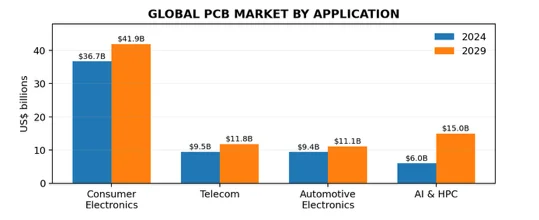
Consumer electronics remains the largest PCB market by revenue. But the most important change is happening in AI and high-performance computing, where PCB demand is growing faster, and the specification burden is much higher.
Source: Global PCB industry overview, HKEX / Frost & Sullivan data. Values shown in US$ billions.
The market hierarchy therefore needs two lenses. By total consumption, consumer electronics is still first. By strategic growth and technical intensity, AI/HPC is becoming the category to watch most closely.
06: THE DEMAND MAP IS WIDER THAN AI SERVERS
07: THE PCB MARKET IS SPLITTING INTO TWO WORLDS
One part of the market is still buying conventional boards on price and standard lead time. The other is buying engineering performance: 18–40+ layer architectures, HDI, low-Dk / low-Df materials, back-drilling, controlled impedance, high-Tg systems, heavy copper and tight registration.
This distinction matters for procurement. Saying “PCBs are hard to source” is too broad. The more accurate statement is that certain specifications are becoming harder to source at the volume, quality and delivery schedule required by modern programs.
For OEMs, that creates a familiar risk pattern: the board that looks cheapest in the RFQ can become the most expensive option if it misses the production window.
“It is the early symptom of a structural transformation that is reshaping the PCB supply chain from the ground up.”
Vexos, “How OEMs Can Navigate AI-Driven PCB & CCL Supply Constraints,” May 2026
08: PROCUREMENT IS BECOMING AN ENGINEERING DECISION
The traditional sourcing question “Can you quote this part?” is no longer sufficient for constrained electronics. The better questions are:
These are not procurement questions in isolation. They are engineering questions with commercial consequences.
09: THE REAL ADVANTAGE IS SUPPLY CONTINUITY
When a market tightens, the advantage does not always belong to the company with the lowest quoted price. It often belongs to the company that already knows where qualified capacity exists, which manufacturers can actually meet the specification, and how to keep that capacity available through the production cycle.
That is the gap between buying a component and building a supply chain.
10: WHERE KTTS FITS
KT Technical Solutions is positioned around that exact problem: connecting engineering requirements with qualified manufacturing and sourcing capability. For programs exposed to memory and PCB constraints, the objective is not simply to locate a part number. It is to identify a realistic, scalable path from requirement to production.
MEMORY OR PCB SUPPLY CONSTRAINING YOUR PROGRAM?
.
SEND YOUR RFQ TODAY.
Share your part number, BOM, drawing, specification, quantity, and required delivery window.
Your requirement. Our sourcing expertise. One connected solution.