POLAND’S DEFENCE INDUSTRIAL SHIFT
Why European defence procurement is moving from buying platforms to building capacity.
The war in Ukraine has changed the defence procurement equation across Europe. The issue is no longer only
what countries can buy. It is increasingly what they can manufacture, replenish, repair, integrate and sustain at
scale.
01: POLAND IS BUILDING FOR A HIGHER THREAT ENVIRONMENT
Poland is emerging as one of Europe’s most important defence industrial markets. Its proximity to the war in
Ukraine and Russia has accelerated force modernisation, while Warsaw is simultaneously pushing to
strengthen domestic manufacturing capability.
Reuters reported in September 2026 that Polish defence procurement from domestic and Central European
companies had increased nearly fourfold since 2022 to PLN 30.4 billion. Poland’s 2026 core defence
expenditure is expected at approximately €53 billion, or about 4.7% of GDP.
02: THE BIGGEST SHIFT IS BELOW THE PLATFORM LEVEL
Headline contracts focus on aircraft, helicopters, air-defence systems, missiles and unmanned platforms. But
every one of these systems depends on an industrial layer of components, assemblies and manufacturing
processes.
That layer includes PCB and PCBA manufacturing, connectors, wire harnesses, cable assemblies, power
electronics, batteries, sensors, communications hardware, precision machining, sheet metal, rugged
enclosures, box builds, testing and systems integration.
03: SAFE IS A SIGNAL OF INDUSTRIAL POLICY
Poland’s SAFE programme is important because it connects defence spending with domestic industrial
capability. In May–June 2026, Poland announced 62 SAFE contracts worth approximately PLN 120 billion, with
contracts directed to Polish defence industry.
The programme covers communications, electronic reconnaissance, air defence and counter-UAS capabilities,
FlyEye UAV sets, WARMATE loitering-munition sets, GLADIUS systems and personal protection equipment.
The industrial implication is broad: electronics, communications, unmanned systems, mechanical assemblies,
power and production capacity all become part of the procurement ecosystem.
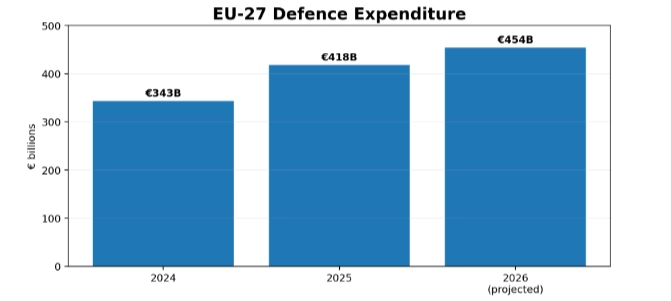
Source: European Defence Agency — Defence Data 2025–2026.
04: EUROPE IS NOT WAITING FOR THE MARKET TO NORMALISE
The wider European trend is equally important. The European Defence Agency reports EU-27 defence
expenditure of €418 billion in 2025, with €454 billion projected for 2026.
France is planning an additional €36 billion in defence spending through 2030, with priorities including air
defence, counter-drone systems, missiles, drones and robotic warfare. Sweden is investing in future manned
and unmanned combat-aircraft technologies. European procurement is also increasingly connected to the
industrial capacity needed to support Ukraine.
05: PROCUREMENT IS BECOMING A CAPACITY QUESTION
For defence manufacturers and their customers, the traditional RFQ question “What is your price?” is
becoming insufficient.
The industry questions are now:
06: THE SUPPLY CHAIN IS NOW PART OF THE ENGINEERING
SPECIFICATION
A technically correct component can still become the wrong engineering decision if it cannot be sourced
consistently at programme volume. Availability, lifecycle, capacity, qualification, lead time and second-source
options increasingly need to be considered before the design is frozen.
Engineering and procurement therefore have to work together. The supply chain should understand the product
not simply the part number.
07: WHERE KTTS FITS
KT Technical Solutions is already supporting clients inside Europe by connecting engineering requirements with
manufacturers, suppliers and technical capabilities.
For defence, UAV, robotics, aerospace and advanced-electronics programmes, the value is in finding a realistic
manufacturing path not simply identifying a catalogue item.
POLAND’S REGIONAL PROCUREMENT GROWTH
Reuters reported that procurement from domestic and Central European companies rose nearly fourfold from
2022 to PLN 30.4 billion. The 2022 figure below is therefore an approximate implied value (~PLN 7.6B), not a
separately reported exact figure.
08: THE EUROPEAN OPPORTUNITY IS INDUSTRIAL
The next phase of European defence spending will not be measured only by the number of platforms ordered. It
will also be measured by how quickly Europe can build, replenish, repair, upgrade and sustain those platforms.
For manufacturers, that creates an opportunity. Companies with qualified processes, credible capacity,
strong quality systems, traceability, engineering support and scalable production are increasingly positioned to
become strategic suppliers.
NEED THE RIGHT SOLUTION FOR YOUR PROJECT?
SEND YOUR RFQ TODAY.
Share your engineering or sourcing requirement with us. KTTS can help evaluate the requirement,
connect you with the right manufacturing capabilities and support the sourcing process from development
through production.
Your requirement. Our sourcing expertise. One connected solution.