NAND Flash Allocation in 2026: What It Means for Industrial Electronics
The availability of electronic components is becoming an increasingly important consideration for manufacturers, engineering teams, and procurement professionals. As demand from AI infrastructure, data centers, electrification, and industrial automation continues to evolve, supply constraints in one component category can affect the broader electronics supply chain.
NAND Flash allocation is one example. Tight memory supply affects the availability and cost of industrial storage, while the same AI-driven expansion is increasing demand for power conversion devices and energy-storage components.
For businesses developing industrial, medical, automotive, energy, and edge-computing systems, understanding these connected market pressures can help inform purchasing decisions, design priorities, and production planning.
This article examines the NAND Flash allocation environment described in the 2026 market outlook, its implications for related electronic components, and practical strategies for managing supply-chain risk.
01: Understanding the NAND Flash Market
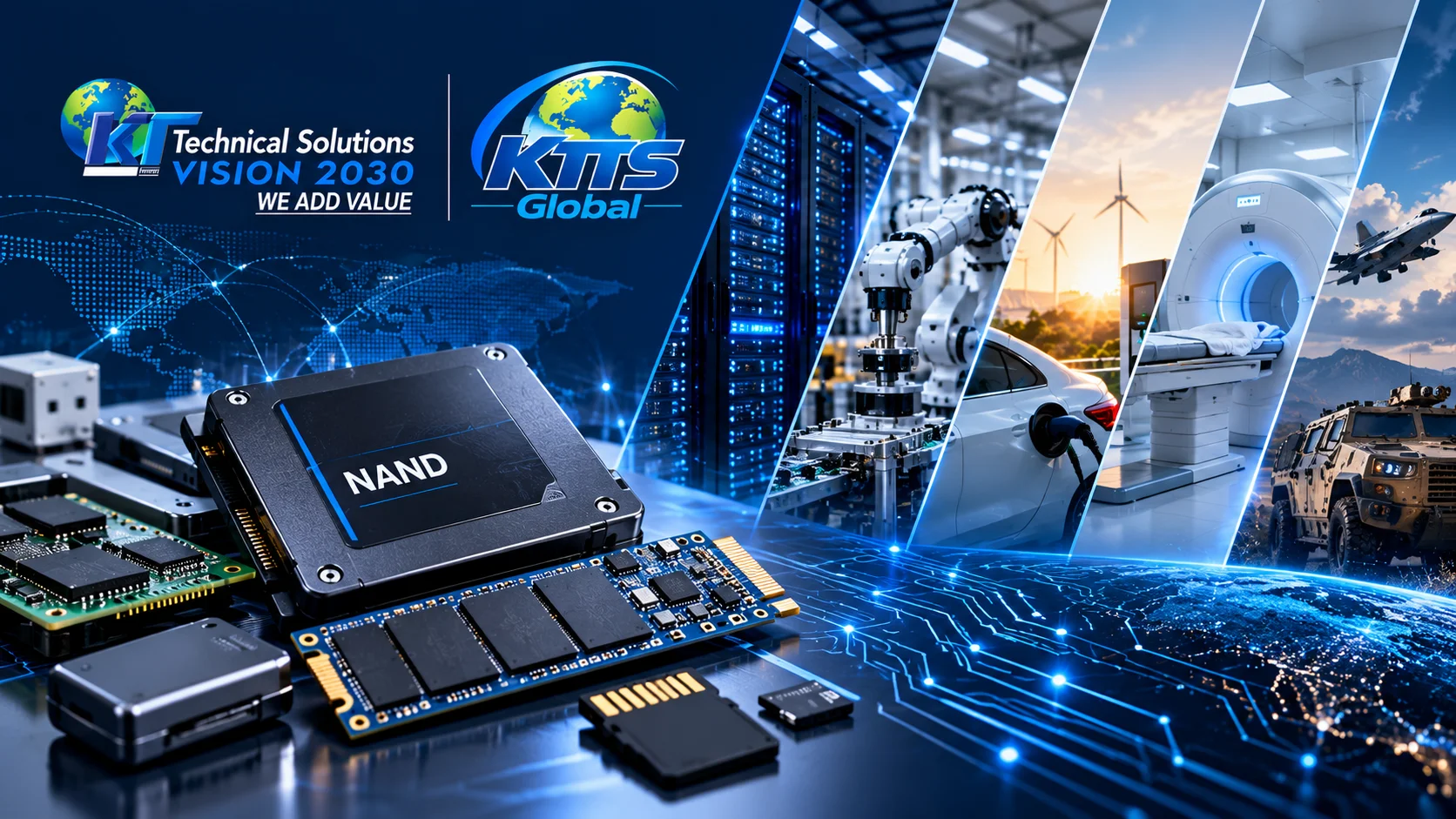
NAND Flash storage is used in industrial SSDs, embedded storage modules, memory cards, and other devices that support data logging, operating systems, firmware, and secure records.
Industrial applications often require more than storage capacity. They may also depend on extended operating-temperature ranges, high endurance, power-loss protection, data integrity, and hardware-level security.
The original market analysis reports that NAND Flash remained undersupplied throughout 2026, with an estimated supply deficit of 4–5%, and some estimates reaching 6–8%.
Several factors contribute to this environment:
The analysis projects that the market may move closer to balance in the second half of 2027, although timing will depend on additional capacity and demand conditions.
02: What Allocation Means for Industrial Buyers
When suppliers prioritize certain customers and product categories, industrial buyers can face longer lead times, tighter allocations, and higher costs.
The original analysis identifies several consequences of the 2026 allocation environment:
For manufacturers using industrial PCs, PLCs, medical imaging equipment, automotive controllers, and edge-computing systems, storage availability can influence production schedules and total bill-of-materials costs.
The practical challenge is not simply finding memory. It is securing the correct grade, capacity, interface, endurance, and lifecycle support for the intended application.
03: Why NAND Allocation Also Matters for Power Conversion and Capacitors
NAND Flash and power conversion devices do not have a direct technical dependency. However, they operate within the same broader electronics ecosystem, where AI infrastructure is influencing demand and capacity across multiple component categories.
AI infrastructure increases power requirements
High-density AI racks require large numbers of high-efficiency AC/DC power supplies, intermediate bus converters, multiphase DC/DC stages, and point-of-load (POL) regulators.
The same expansion driving demand for enterprise storage is also increasing demand for power conversion products. IGBT and SiC gate-drive DC/DC converters benefit from related growth in server infrastructure and energy storage.
Semiconductor capacity constraints can spread
When memory manufacturers prioritize high-bandwidth memory (HBM) and advanced NAND, broader fabrication, packaging, and test capacity can become tighter.
This can contribute to longer lead times and allocation for related power semiconductors, including IGBT modules and SiC devices, particularly in automotive and industrial grades.
The original analysis also identifies multi-week lead times for high-capacitance multilayer ceramic capacitors (MLCCs) and polymer capacitors, sometimes reaching 20–50 weeks.
These examples illustrate why procurement teams should consider supply risks across related component categories rather than evaluating memory availability in isolation.
Higher power density increases capacitor requirements
Large aluminum electrolytic capacitors are important for DC-link filtering, bulk energy storage, and power hold-up in systems such as AI servers, EV chargers, renewable-energy inverters, and industrial drives.
As power density increases, system designs may require higher capacitance and ripple-current ratings. Meanwhile, constraints involving high-purity aluminum foil can add pressure to capacitor supply.
Production slowdowns in flash-dependent end equipment may also create demand volatility for associated power and passive components.
04: The Cost and Design Implications
Higher flash prices can increase the bill-of-materials cost of systems containing SSDs, eMMC, or memory cards.
OEMs may respond by:
Industrial and automotive manufacturers face particular challenges because they may need specialized memory while competing for power-conversion and capacitor capacity also sought by AI infrastructure, EVs, and renewable-energy applications.
05: Practical Supply-Chain Strategies
The allocation environment reinforces the importance of proactive procurement and engineering coordination.
Secure supply earlier. Work with suppliers and Electronics Manufacturing Services (EMS) partners to understand lead times and establish rolling 3-, 6-, or 12-month blanket orders where appropriate.
Evaluate dual sourcing. Identify alternative sources for critical components before shortages affect production. Any substitute must meet the design’s electrical, mechanical, security, lifecycle, and qualification requirements.
Review design flexibility. Where technically and commercially appropriate, assess whether alternative storage configurations or components can meet system requirements without compromising reliability.
Coordinate across component categories. Plan for memory, power conversion devices, and passive components together, especially when they support the same end equipment.
Protect lifecycle requirements. Industrial and medical systems may require long-term availability, extended-temperature operation, and application-specific compliance. Alternative components should be evaluated against these needs before approval.
These measures cannot eliminate market shortages, but they can improve visibility, reduce dependence on spot purchasing, and help teams make better-informed sourcing decisions.
Conclusion
The 2026 NAND Flash allocation environment highlights how demand from AI infrastructure can influence component availability and cost across the wider electronics supply chain.
Industrial memory remains essential for reliable data handling, while power conversion devices and capacitors support the stable, efficient operation of the systems that depend on it. When several component categories face pressure at the same time, late-stage purchasing decisions become more difficult and production schedules more vulnerable.
For engineering and procurement teams, the priority is to plan early, evaluate qualified alternatives, and coordinate sourcing across the complete system bill of materials.
Long-term agreements, dual sourcing, and design flexibility can help businesses manage uncertainty while maintaining the reliability and lifecycle support required for industrial, medical, automotive, energy, and edge applications.
The key takeaway: Supply-chain resilience depends on looking beyond individual components and planning for the connected requirements of the complete system.
Need help navigating component availability or identifying suitable electronic components for your application?
Connect with KT Technical Solutions to discuss your requirements.
Your requirement. Our sourcing expertise. One connected solution.